
25
May 2026
3rd Jun 2026
As global aerospace production accelerates and defence spending increases across Europe, manufacturers throughout the supply chain are facing a common challenge: delivering increasingly complex precision components at higher volumes without compromising quality or lead times. Sliding head CNC machining has become an increasingly important part of the solution. Traditionally associated with the production of small, intricate turned parts, modern sliding head technology has evolved significantly over the past decade. Today’s machines are capable of producing highly complex components in a single operation, reducing handling, improving repeatability and delivering the levels of precision demanded by sectors where performance and reliability are non-negotiable.
For aerospace and defence customers, those benefits are becoming increasingly valuable. Aircraft manufacturers continue to work through substantial order backlogs while defence programmes across Europe are expanding in response to changing geopolitical priorities. As production rates rise, suppliers are under pressure to provide greater capacity while maintaining strict quality standards and full traceability.
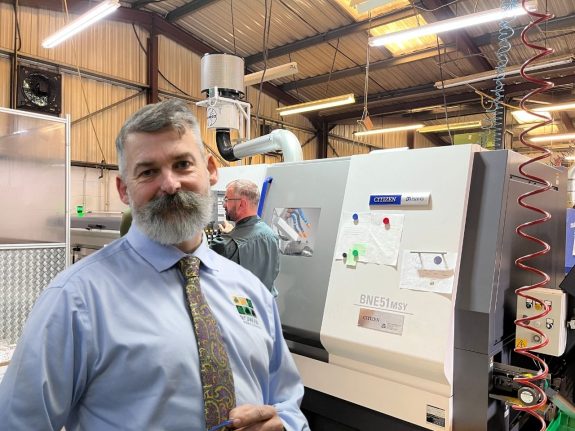
At Rowan Precision, investment in advanced sliding head technology has been driven by these changing customer requirements. Neil Williams, Technical Sales Manager at Rowan Precision, believes the technology is playing a growing role in helping manufacturers address both technical and commercial challenges.
“Customers are looking for partners who can deliver precision, consistency and responsiveness simultaneously,” he said. “Sliding head machining allows us to produce highly complex parts with exceptional repeatability while also supporting the production volumes that aerospace and defence programmes increasingly require.”
One of the key advantages of sliding head machining lies in its ability to support long, slender components during manufacture. By guiding material close to the cutting point, vibration is reduced and dimensional accuracy improved. The result is tighter tolerances, better surface finishes and greater process stability.
Those capabilities make the technology particularly well suited to critical aerospace and defence applications where component performance is directly linked to safety and operational reliability. The benefits extend beyond engineering performance alone.
As supply chains seek greater resilience, manufacturers are increasingly evaluating how processes can be consolidated and lead times reduced. Modern sliding head machines can perform multiple operations within a single setup, reducing the need for secondary processing and helping improve production efficiency. For Rowan Precision in Birmingham, these efficiencies form part of a broader commitment to supporting customers through long-term partnerships rather than individual transactions.
Glenn Aston, Chief Financial Officer, believes investment in advanced manufacturing technology must ultimately be aligned to customer outcomes.
“Technology investment only creates value when it helps customers solve real challenges,” he said. “Our focus is on building capability that enables reliability, scalability and long-term competitiveness for the sectors we serve.”
As aerospace and defence markets continue to evolve, manufacturers capable of combining technical expertise with production flexibility will become increasingly important. While sliding head technology may operate behind the scenes, its contribution to precision engineering is becoming ever more visible. In a sector defined by performance, quality and resilience, it is helping shape the next generation of manufacturing capability.
For companies seeking dependable supply partners, that capability could prove to be one of the industry’s most valuable assets.