
06
Oct 2026
12th Mar 2026
A wave of investment and technological breakthroughs across the UK’s defence and advanced materials industries is providing a powerful signal of confidence for British manufacturing — reinforcing the country’s position as a global centre for high-value, precision engineering.
Recent developments involving companies such as defence mobility specialist Supacat and advanced materials manufacturer Cross Manufacturing demonstrate how the UK continues to convert engineering innovation into deployable capability, export opportunity and skilled employment across the supply chain.
Supacat’s continued evolution as a leading designer and manufacturer of high-mobility defence vehicles highlights the strength of British engineering in demanding global markets. From its origins developing the All-Terrain Mobility Platform in the early 1980s to today’s globally deployed High Mobility Transport (HMT) vehicles — known to British troops as the Jackal and Coyote — the company has built a reputation for innovation in extreme environments.
More than 1,000 HMT vehicles are now in service worldwide, while the latest Jackal 3 variants continue to roll off production lines to support British Army operations and export customers. The programme also illustrates the importance of a resilient domestic supply chain, with the majority of suppliers located within the UK.
Alongside vehicle manufacturing successes, the sector has also seen breakthroughs in advanced materials. Cross Manufacturing recently achieved a UK first by establishing a pilot-scale end-to-end manufacturing process for ceramic matrix composites (CMCs) — ultra-high-temperature materials with applications in aerospace, defence and energy systems.
Developed in partnership with the Defence Science and Technology Laboratory (Dstl), the capability marks a significant step toward bringing strategic materials production onshore and strengthening the UK’s sovereign industrial base.
For companies operating within the precision engineering supply chain, these developments demonstrate the continued relevance of British manufacturing in globally competitive sectors.
Glenn Aston, Chief Financial Officer at Rowan Precision, believes the success of firms such as Supacat and Cross Manufacturing sends a clear message about the UK’s ability to compete in advanced manufacturing markets.
“What we’re seeing across the defence and aerospace ecosystem is evidence that the UK remains exceptionally strong in high-value, engineering-led manufacturing,” said Aston. “Companies like Supacat demonstrate how British design capability, innovation and specialist supply chains can produce world-leading platforms that are exported globally. Its one of the reasons why he hold the AS9100 accreditatiton.”
Aston noted that the impact extends far beyond prime contractors.
“Behind every major defence programme is a network of precision engineering companies supplying highly specialised components and assemblies. These programmes lift the entire sector because they require advanced machining, quality systems and engineering expertise that firms like Rowan Precision have spent decades developing.”
He added that the UK’s strength lies in its ability to combine innovation, engineering skills and rigorous quality standards.
“In markets such as aerospace and defence, customers are looking for reliability, traceability and absolute precision. The UK has built a global reputation in these areas, particularly through AS9100 and other sector-specific standards that underpin high-integrity manufacturing.”
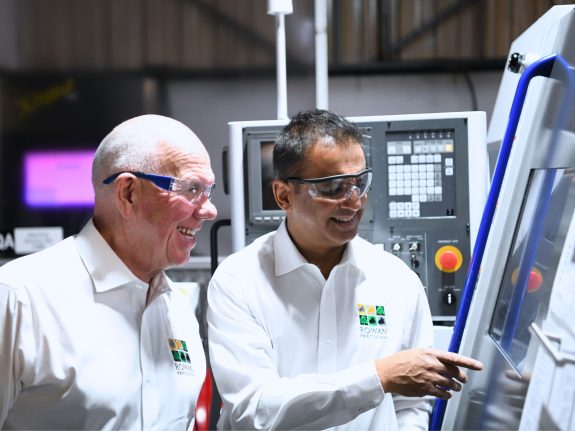
Rowan Precision, which specialises in high-precision sliding head machining for aerospace and defence applications, sees sustained investment in UK defence capability as a major opportunity for the domestic supply chain.
“When you see new vehicle platforms, advanced materials development and defence programmes moving forward in the UK, it reinforces confidence across the entire manufacturing ecosystem,” Aston added. “It proves that the country still has a critical role to play in delivering complex, high-performance engineering products to the global market.”
As defence programmes increasingly emphasise sovereign capability and resilient supply chains, the success of companies like Supacat — supported by specialist manufacturers across the UK — underlines a broader truth: Britain’s future in manufacturing lies firmly in high-value, innovation-driven engineering.
For the precision manufacturing community, that is a message worth celebrating.