
06
Oct 2026
26th Mar 2026
Against a backdrop of subdued order books, rising input costs and persistent global uncertainty, leaders in UK manufacturing are being urged to double down on investment, collaboration and capability rather than retreat.
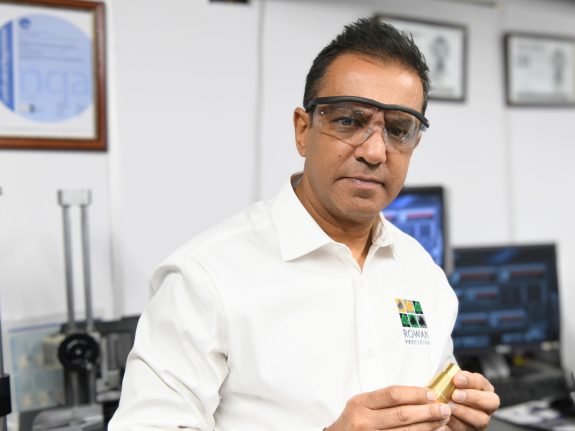
Fresh from a roundtable discussion with industry peers, Rowan Precision’s Chief Operating Officer, Jaz Khunkun, remains resolutely optimistic about the sector’s long-term prospects — even as short-term indicators paint a challenging picture.
Recent data from the Confederation of British Industry (CBI) highlights that manufacturing order books remain well below historical averages, while price pressures continue to intensify amid rising energy costs and fragile global supply chains. Yet, for Khunkun, the narrative is far from one of decline.
“There’s no doubt the macroeconomic environment is tough — but UK manufacturing has always been resilient,” he explains. “Confidence is critical. Business leaders need to show leadership, continue investing and push forward. That’s how this sector has always prevailed.”
At Rowan Precision, that confidence is rooted in capability. Operating from Birmingham, the company has continued to invest in advanced CNC machining technologies, spanning both fixed head and sliding head platforms — a combination that enables flexibility across complex, high-specification components.
This dual capability positions the business to serve demanding sectors such as aerospace and medical devices, where consistency, traceability and micron-level precision are non-negotiable.
Rowan Precision’s accreditations reinforce that positioning. With AS9100 underpinning its aerospace work and ISO 13485 supporting its expansion into medical manufacturing, the company reflects a broader shift within UK industry towards high-value, regulated markets.
“The UK’s strength lies in high-value, high-complexity manufacturing,” Khunkun adds. “We’re not competing on volume — we’re competing on precision, quality and trust.”
While surveys suggest output may soften in the months ahead, Khunkun believes the current climate should act as a catalyst for smarter, more collaborative approaches across the sector.
From energy costs and infrastructure constraints to skills shortages and supply chain volatility, the challenges are well documented. However, so too is the scale of opportunity — particularly within advanced manufacturing, where government-backed investment and emerging technologies continue to reshape the industrial landscape.
“We need to be more joined-up as an industry,” he says. “That means closer collaboration between manufacturers, stronger engagement with customers, and a willingness to innovate — whether that’s through automation, digitalisation or new materials.”
“We have to promote what UK manufacturing is capable of. There’s world-class engineering happening across the country, but we need to be louder about it — both domestically and internationally.”
For Rowan Precision, the path forward is clear: continue investing, continue improving, and continue leading from the front.
Despite economic headwinds, the company is maintaining its focus on capability development, process control and long-term partnerships — a strategy Khunkun believes will define the next phase of UK manufacturing growth.
“Periods like this test businesses,” he concludes. “But they also create opportunity. The companies that stay confident, invest wisely and collaborate effectively will be the ones that come out stronger.”
In a sector that contributes billions to the UK economy and underpins critical industries from aerospace to healthcare, that message may prove as important as any economic indicator.