
15
Feb 2026
22nd Feb 2026
The UK manufacturing sector’s £21bn surge in output during 2025 has reinforced what many in advanced engineering have long argued: high-value, precision-led production is where British industry truly competes. According to analysis of Office for National Statistics data by FourJaw Manufacturing Analytics, factory output climbed 3.4% to nearly £639bn last year, marking the fifth consecutive year of growth in both output and productivity. Real-terms production is now 27.8% higher than in 2020, despite a reduction of more than 36,000 workers and 2,500 fewer manufacturers.
For Birmingham-based precision engineering specialist Rowan Precision, the figures are clear evidence that skill, investment and technical depth are driving a more focused, more capable sector.
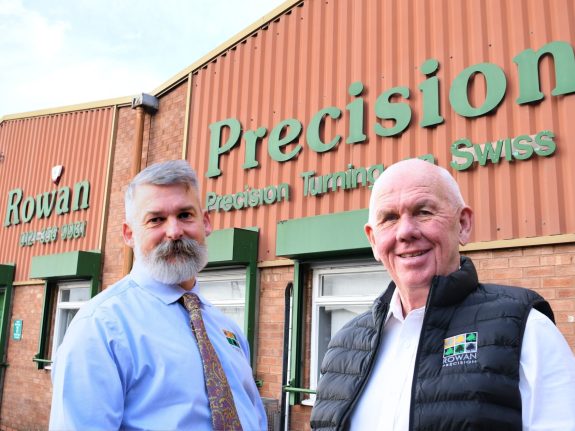
“It’s a powerful message for UK manufacturing,” said CFO Glenn Aston. “The data shows that output is rising even as the workforce contracts. That tells you productivity, automation and precision are doing the heavy lifting. It’s no longer about volume alone — it’s about value.”
Growth in 2025 was led by aerospace (£6.7bn), chemicals and pharmaceuticals (£4.2bn), metals and machinery (£2.6bn), and computers and electrical products (£1.9bn) — sectors where tolerances are tight, compliance is critical and component performance is non-negotiable. Rowan Precision, which supplies complex machined components into demanding industrial and advanced engineering markets, sees the trend as validation of its long-standing focus on high-specification CNC machining and sliding head technology.
“With multi-axis CNC machining and advanced sliding head capability, you’re maximising material efficiency, cycle time and repeatability,” explained Technical Sales Manager Neil Williams. “That’s exactly what productivity means in modern manufacturing — extracting more performance from every machine, every setup and every skilled operator.”
He added: “When customers are consolidating supply chains and demanding tighter tolerances, it’s specialist manufacturers with deep technical capability who step forward.”
Founded on a proud heritage of precision machining, Rowan Precision has built its reputation on complex turned and milled components where accuracy is measured in microns and consistency is paramount. Its sliding head technology allows for the efficient production of intricate, high-precision parts — particularly suited to aerospace, defence and high-performance industrial applications. As average output per employee rose by 2.9% in 2025 — equivalent to around £7,000 more per worker in real terms — Aston believes the sector’s trajectory reflects years of steady investment in both machinery and skills.
“Productivity gains don’t happen overnight,” he said. “They’re the result of sustained capital investment, digital integration and a culture that values engineering expertise. High value-add manufacturing is where skill and precision really pay off — and that’s where the UK is strongest.”
While automotive output declined amid trade pressures and operational disruption elsewhere in the sector, the broader manufacturing landscape points to a rebalancing toward high-technology, export-led and compliance-driven industries. For Rowan Precision, the message is clear: resilience lies in capability.
“This isn’t about chasing volume,” Williams concluded. “It’s about delivering complex components right first time, every time. Customers want partners who can add engineering value — not just capacity. That’s the difference between commodity production and precision manufacturing.”
As the sector enters its sixth consecutive year of performance improvement, businesses like Rowan Precision argue that Britain’s competitive advantage will continue to rest not on scale alone, but on its ability to engineer smarter, tighter and more efficiently than its global peers.
In a leaner industry landscape, precision is no longer just a technical requirement — it is a commercial strategy.