
06
Oct 2026
17th Aug 2026
For manufacturers investing in automation, advanced machine tools and increasingly sophisticated production systems, one factor continues to determine how effectively that technology translates into productivity: people. At Birmingham-based Rowan Precision, developing those people has become an integral part of its manufacturing strategy. The CNC machining specialists have spent recent years building an apprenticeship and workforce development model around real manufacturing experience, exposing emerging engineers to CNC machining, quality, metrology, process planning and the wider commercial disciplines that sit behind the production of high-specification components.
It is an approach that reflects a wider shift across UK manufacturing. Apprenticeship starts across England have risen during the current academic year, while manufacturers are placing greater emphasis on reskilling, flexible technical training and employer-led development. Make UK recently launched accelerated engineering apprenticeship and short-course routes from its Technology Hub in Aston, Birmingham, highlighting the appetite for more adaptable pathways into engineering skills. For Rowan Precision CFO Glenn Aston, developing capability from within provides manufacturers with an opportunity to shape skills around the technologies, standards and customer requirements they encounter every day.
“Skills development works best when it is connected directly to the reality of manufacturing,” said Aston. “An apprentice at Rowan is learning within an environment where precision, quality, traceability and productivity matter every day. They can see how the individual skills they develop contribute to the performance of the whole business.”
Rowan Precision’s manufacturing environment itself provides a particularly broad technical classroom. Its capabilities include sliding-head 13-axis CNC turning, multi-axis fixed-head mill-turn centres and five-axis machining cells, alongside the quality and process controls required to support customers across demanding sectors including aerospace and defence. For an apprentice, that means manufacturing education extends considerably further than learning how to operate a machine. Understanding tooling, workholding, materials, inspection, metrology, drawings, tolerances, process planning and quality documentation all contribute to becoming an effective modern manufacturing engineer.
That breadth is increasingly relevant as manufacturers seek people capable of moving confidently between traditional engineering knowledge and digital manufacturing technology.
“The engineer we are developing today is going to have an increasingly broad skillset,” Aston explained. “Machining knowledge remains fundamental to our business, and alongside that comes CAD, data, automation, metrology, process control and an understanding of the quality systems our customers expect. “Our role as an employer is to create an environment where those skills can develop together.”
That philosophy closely reflects the skills conversation taking place across UK industry. Recent initiatives highlighted by The Manufacturer include apprenticeship programmes embedding trainees directly within operational teams, while new modular training approaches increasingly combine established engineering disciplines with CNC, CAD, robotics and other advanced manufacturing technologies. Rowan Precision’s approach also extends beyond the factory.
At MACH 2026, apprentices from the company represented Rowan Precision alongside Make UK, engaging with students, manufacturers and prospective customers at the NEC. The experience offered an opportunity to see the wider manufacturing landscape while developing communication, confidence and commercial awareness. Feedback from Make UK praised the apprentices for the way they engaged with students and industry visitors.
Aston sees experiences such as MACH as an important part of creating rounded manufacturing professionals.
“We want apprentices to understand the industry they are joining, rather than simply the individual process they are learning,” he said. “MACH gave them the opportunity to talk about engineering, meet other manufacturers and represent Rowan Precision themselves. Seeing them confidently explaining what they do was a real measure of their development.” There is also a wider benefit in that young engineers talking enthusiastically about their careers can provide one of manufacturing’s most effective recruitment tools. It gives school and college students an opportunity to hear directly from people close to their own age who have already chosen a technical pathway.
This employer engagement is becoming increasingly important. University Technical Colleges, for example, are working with more than 400 employers to connect technical education directly with the workplace, while a fifth of Year 13 UTC leavers progressed into apprenticeships during 2025.
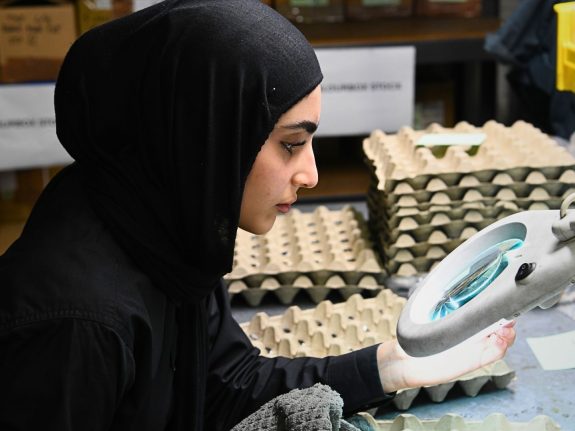
The results of Rowan Precision’s approach can be seen through individual career journeys. Apprentice Engineering Support professional Khadijah Zaman and Apprentice CNC Machinist Sheriyar Hussain are among the emerging talent developing within the company, while William Robinson has used an apprenticeship as a route to progress further after already gaining shopfloor experience. Another example is Ricardo Morgan. Morgan joined Rowan Precision in January 2023 and continued his degree apprenticeship at Aston University while working within the business. His development incorporated practical CNC machining experience and exposure to the wider engineering environment before he completed his apprenticeship with a 2:1 classification. His progression subsequently took him to BMW in 2026.
For Rowan Precision, that journey represents something significant about the role SMEs can play within Britain’s engineering skills ecosystem.
“Ricardo’s progression is something we can take a great deal of pride in,” Aston said. “We were able to participate in his development, give him meaningful manufacturing experience and watch him grow both professionally and personally. When someone develops with you and progresses into another major engineering organisation, that demonstrates the value manufacturing SMEs can create for the wider skills base.”
This is perhaps where Rowan Precision’s experience offers its most useful lesson. Skills investment and capital investment increasingly belong in the same conversation. A sophisticated CNC machine tool creates capability. Skilled engineers determine how extensively that capability can be applied through programming, tooling strategy, process optimisation, inspection and continuous improvement. The same relationship applies to automation, digital manufacturing and quality technology.
“We naturally talk about investment in terms of machines, software and equipment because those investments are highly visible,” Aston said. “The investment in the person standing alongside that technology is equally important. “When you develop somebody who understands the machine, the process, the component and the quality requirement, you are building productive capability that can stay within British manufacturing for decades.”
The wider industry appears to be moving in the same direction. Recent apprenticeship programmes profiled by The Manufacturer increasingly position vocational training as part of workforce planning, productivity and long-term manufacturing capability rather than simply an early-careers recruitment exercise. For an SME, creating that pipeline requires commitment. Apprentices need mentoring, structured development, meaningful responsibility and access to experienced engineers whose own knowledge has often been accumulated over decades. The return is a workforce developed around the realities of the business.
For Rowan Precision, that means people learning precision engineering within a production environment serving sophisticated supply chains, while simultaneously understanding the quality culture and technical discipline associated with advanced manufacturing. It also creates continuity between generations as experienced machinists transfer practical knowledge. Apprentices bring new perspectives and digital confidence and training providers add structured learning. Investment in modern manufacturing technology gives those skills somewhere to develop.
Aston believes that combination provides a model with relevance well beyond Rowan Precision. “Manufacturing skills are created through opportunity,” he concluded. “Give people access to good training, experienced mentors, modern technology and genuine responsibility and you create an environment where they can build valuable careers. “For Rowan Precision, apprenticeship success is ultimately about developing engineers. For UK manufacturing, every engineer we develop strengthens the capability available to the wider industry. That is why skills remain one of the most important investments we can make.”
As manufacturers plan for the next generation of technology, productivity and growth, Rowan Precision’s experience illustrates a practical principle: manufacturing capability can be purchased in machinery, but manufacturing knowledge has to be developed in people.